The Candy Aisle Is a Screening Room: What Twelve Gas-Station Snacks Taught Me About Watching Movies
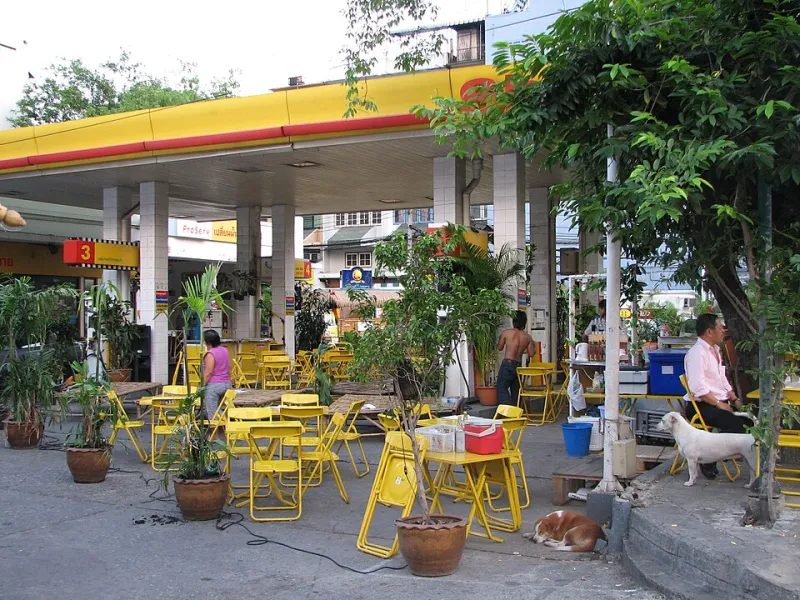
Photo: McKay Savage from London, UK, CC BY 2.0, via Wikimedia Commons
The snack run used to be an afterthought for me. I would grab whatever was closest to the register, balance it on the arm of the couch, and forget about it by the second act. Then, somewhere between a bag of sour gummies and a truck-stop jerky stick, I started paying attention to what the snack was doing to the movie. Not to the plot. To my experience of the plot.
So I turned it into a month-long experiment. Twelve movies, twelve convenience-store snacks, one rule: no dinner-party energy. Nothing plated. Nothing that needed a fork. If I could not buy it under fluorescent lights with a roller grill humming in the background, it was out. The point was not to become a food critic. The point was to see whether the thing in my hand changes the thing on the screen.
It does. Here is how.
The Loud Snack Is a Scene Partner Whether You Like It or Not
I paired a family-size bag of kettle chips with a quiet, dialogue-heavy drama about two people cleaning out a dead relative's house. Within ten minutes I understood something I had never fully admitted: crunching is a form of commentary. Every chip was a tiny interruption, and the movie's silences—the ones doing the real emotional work—kept getting stepped on by my own jaw.
That is not automatically bad. A loud snack can actually pull you into a tense scene, because your body is doing something and your brain stays in the room. But it can also flatten a delicate moment into background noise. The lesson was not "never eat chips during a drama." The lesson was: match your noise level to the movie's noise level. If the film is whispering, chew like you are trying not to wake someone.
Sour Candy, Slow Burns, and the Art of Staying Awake
My best accidental discovery was a roll of sour candy paired with a three-hour slow-burn thriller. I am not proud of this, but I have dozed off during slow burns before. The sour candy fixed it. The sharpness kept my mouth busy and my attention anchored, and every time the film downshifted into a long, quiet shot, I was still there, waiting.
This is where the gas-station candy counter starts to feel like a film school. A snack is a pacing tool. Sweet and soft encourages comfort; sour and chewy encourages alertness. If you know a movie is going to test your patience—and some great ones do—pick a snack that agrees to test it with you instead of tucking you in.
Jerky, Westerns, and the Dignity of Chewing
The truck-stop jerky pairing was a Western, because of course it was. What surprised me was how the chewing changed the rhythm. Jerky takes time. You cannot rush it, and you cannot really talk over it. For two hours I watched a movie about hard men making hard choices while I made the hardest choice available to me, which was whether to keep working on a single piece of meat.
It slowed me down. The movie's wide shots had room to breathe. I noticed the landscape more than I usually would. I am not going to claim jerky is a cinematic technique, but I will claim this: a snack that forces you to slow down can make a slow movie feel intentional instead of interminable.
The Melty Chocolate Problem
Not every pairing worked. I tried a chocolate bar with a tight, sweaty thriller, and the chocolate turned to mush in my hand about twenty minutes in. I spent the next hour managing a wrapper and a sticky palm while the movie tried to keep me on edge. The thriller was fine. I was the problem.
That was the clearest lesson of the whole month: texture and temperature matter more than flavor. Cold, clean, and one-handed beats rich and complicated every time. A movie night is not a tasting menu. If the snack demands your attention, it is competing with the film, and the film will lose.
The Cheat Sheet I Actually Use Now
I am not going to pretend I have a scientific system, but I do have a short list of rules that survived the month.
- One hand, one wrapper. If opening it takes two hands and a lap, it is a dinner, not a snack.
- Match the noise. Quiet movie, quiet snack. Loud movie, go ahead and crunch.
- Contrast temperature, not flavor. A cold drink with a warm snack keeps things interesting without turning into a mess.
- Portion for the runtime. A giant bag invites mindless eating; a small bag invites attention.
- Keep a clean hand. This sounds obvious until you are three scenes into a movie with a sticky remote.
- Do not overthink the pairing. The best snack is the one you forget you are eating because the movie has you.
Why the Snack Run Counts as Part of the Movie
Here is the argument underneath all of this: ritual is not decoration. The trip to the gas station, the walk down the candy aisle, the small decision about what to bring home—those are the opening scenes of the movie night. They tell your brain that something is about to happen. They slow you down enough to actually arrive.
We talk a lot about attention spans like they are broken machines, but a lot of the time we are just out of practice. A snack does not fix that. But a deliberate snack, chosen for a deliberate movie, can be a small hand on the shoulder. It says: stay here. This is the good part.
Twelve pairings later, I do not have a favorite candy. I have a favorite feeling, which is the two minutes before the movie starts, when the lights are low, the wrapper is open, and nothing has happened yet. That is the part the gas station gave me. The movies did the rest.