The Spare Room Fights Back: A $400 Weekend That Turned My Dead Corner Into a Real Studio
For three years, the second bedroom of my apartment had exactly one job: absorbing whatever I didn't feel like dealing with. A road bike I rode twice. Two boxes labeled "cables" in handwriting I swear isn't mine. A folding chair that came with the place and will probably outlast the building.
Meanwhile, I was making things on whatever flat surface happened to be free. Scripts at the kitchen table. Podcast episodes recorded on the couch with a blanket over my head like a kid building a fort. Video calls where I apologized for the echo before anyone else could bring it up. In early October I counted how many times in a single week I'd said "hang on, I need to move the lamp," and that was the end of the debate.
The budget was $400. Not a typo, not a humblebrag. Four hundred dollars and one long weekend, plus a Tuesday night for the stuff I got wrong.
The Before Picture Was Not Cute
Beige carpet with a history. One sad overhead fixture that made every human being in the frame look mildly unwell. A backdrop made of a bedsheet taped to the wall, reapplied so many times the tape looked like a scar. My microphone sat on a stack of paperbacks and the pop filter was, and I cannot stress this enough, a sock.
Here's the thing though — the gear wasn't the real problem. The friction was. Every idea came with a setup tax. Fifteen minutes of untangling, dragging, taping, and adjusting before I could hit record, and another ten minutes of undoing it afterward. Most nights I just didn't pay the tax. I'd open my laptop, look at the room, and quietly go write in the kitchen instead.
I stopped calling it a studio. I started calling it the room where the studio would go.
Three Purchases That Did the Heavy Lifting
I bought way more than three things. But if I'm honest about what changed the room from unusable to genuinely fun, it comes down to these.
1. A bi-color LED panel with a softbox — $129
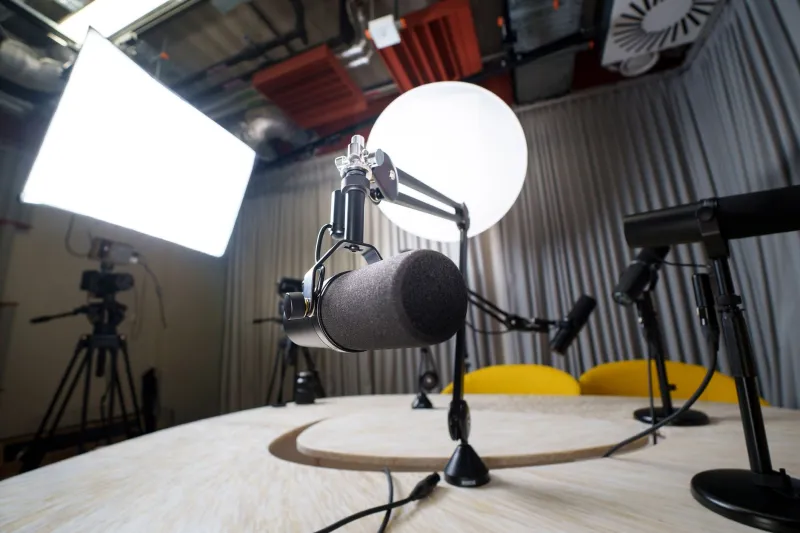
I spent weeks reading about key lights and got exactly nowhere, because the reviews are written by people who light things professionally and I light things in a spare bedroom with a smoke detector on the ceiling. What I needed was: on, off, warm, cool, bright enough. That's it.
A single panel with a softbox, clamped to a shelf bracket and aimed slightly off-axis, fixed 80% of my video problems in one afternoon. Faces look like faces now. I can shoot at 9 p.m. in December and it's fine. The softbox matters more than the panel — bare LEDs give you that hostage-video look, and the diffusion is what makes it feel like a room instead of an interrogation.
2. A quilted moving blanket and a curtain rod — $52
The foam-panel industrial complex had me convinced I needed a wall of hexagons. What I actually needed was mass and softness. I hung a heavy quilted moving blanket on a tension rod across the one hard wall that was bouncing sound directly into the microphone, and the echo dropped off a cliff.
Total cost: the blanket, the rod, and about twenty minutes with a drill. It's not acoustically perfect. It doesn't need to be. It went from "this sounds like a bathroom" to "this sounds like a person talking in a room."
3. A dynamic USB microphone — $99
This one hurt, because I already owned a condenser mic that was, on paper, better. On paper it also picked up the neighbor's dog, the radiator, and what I'm fairly sure was a bus two blocks away. A dynamic mic is less sensitive, which sounds like a downgrade until you realize that less sensitivity is the entire point in an untreated bedroom.
I plug it straight into the laptop, no interface, no software chain to troubleshoot at 11 p.m. If a thing requires me to remember a settings page, I will not use it.
The Boring $120 Nobody Writes About
The remaining money went to the least glamorous cart on the internet: a low-pile rug to kill the floor bounce, two adhesive cable trays, a wall shelf that got the mic off the books, a small lamp for warm background light, a label maker, and a can of paint I bought too early. More on that in a second.
Mistakes I'd Skip Next Time
Painting after mounting. I painted the wall, then realized the light clamp needed a different spot, then patched, then repainted a four-inch square like a person who has never done this before. Paint first. Always paint first.
Buying a big desk. My first instinct was a six-foot desk because "studios have big desks." My room is nine feet wide. I returned it and used a narrow console table I already owned. The floor space I kept is worth more than the desk surface I gave up.
Chasing the aesthetic before the function. The hexagon foam looks great in photos and did almost nothing for my specific room. Buy for your actual problem — mine was a hard parallel wall, not a lack of decoration.
Buying one more thing than I needed. I almost bought a ring light, a second panel, a boom arm, and a teleprompter app in the same cart. Every one of those would have added a decision to my setup. Decisions are friction. Friction is the enemy.
No off switch. For the first two weeks I worked in that room until midnight because it finally felt good to be in there. That's not a studio upgrade, that's a sleep problem. Now the lamp goes off at 9 and the room goes quiet.
What the Room Feels Like Now
The setup takes about ninety seconds. Light on, mic on, blanket already hanging, laptop already plugged in. I record a podcast segment, shoot a short video, and pivot to writing at the same table without moving a single piece of furniture. When I'm done, everything resets in under two minutes because everything has a hook, a tray, or a shelf.
That's the part I didn't expect. I thought I was buying gear. What I actually bought was the removal of a tax I'd been paying for three years without noticing. The room feels like play again, and play is the only reason any of this was ever fun.
A Checklist You Can Steal
- Empty the room completely. Everything out, including the stuff you "definitely need in here."
- Count your outlets. You will need more than you think. Add a strip before you add anything else.
- Decide your single biggest problem — echo, light, clutter, cables — and solve only that first.
- Paint or patch before anything gets mounted.
- Buy one light with diffusion, not three lights without it.
- Hang something heavy and soft on the wall the mic points at.
- Get the mic off the desk and off the books. A cheap arm beats a stack of paperbacks.
- Give every cable a home the day it arrives, or it will live on the floor forever.
- Keep one surface clear on purpose. It's the difference between a room and a workbench.
- Set a shutdown time and actually honor it.
Four hundred dollars didn't buy me a studio. It bought me a room that stops arguing with me every time I have an idea. That's the whole upgrade.