Heads, Tails, and Taste: What Happened When Chance Took Over My Watchlist
Thirty days. One quarter. Every entertainment decision handed to a piece of metal that has no idea who I am.
That was the deal I made with myself on a Sunday night in late September 2026, after the fourth straight evening of scrolling a home screen for twenty minutes and then watching absolutely nothing. My watchlist had 141 titles on it. I had added every single one with real excitement. I wanted to watch roughly zero of them.
So I flipped a coin instead. Heads meant the pick came from the physical stash, the shelf of Blu-rays and thrift-store DVDs I refuse to box up. Tails meant the algorithm got its say. I added two wildcards to keep it interesting: a local event, and an old favorite I had already seen twice.
Four options, one coin, thirty nights. Below is the honest ledger.
The Rules, Which I Broke Only Twice
One flip per night. No vetoes. No mid-watch switching, which turned out to be the hardest rule by a mile. I logged one line about each pick the next morning, before coffee, before I could talk myself into a more generous opinion.
I broke the rules on night eleven (a friend called) and night twenty-three (I fell asleep in the first ten minutes, which I am counting as a rule break against myself). Otherwise the quarter ran the show.
Week One: The Coin Sends Me to a Strip Mall
The first tails landed on a title I had been avoiding for a year because the thumbnail looked like homework. I watched it in two sittings and liked it more than anything I had chosen on purpose since spring. That is the embarrassing part of this experiment: the randomizer did better than my own judgment in week one.
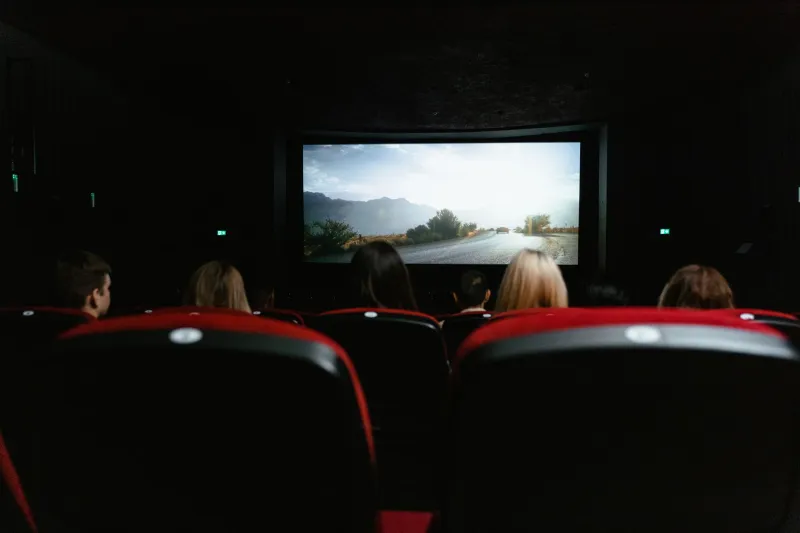
Heads came up next and put me in front of a second-run theater wedged between a laundromat and a taqueria, where a Tuesday night screening of Heat (1995) played to eleven people. Two of them brought their own popcorn. The projector had a faint green bloom in the corner for the first twenty minutes and nobody complained, because the sound was enormous and the room was small and that is a combination no home setup has ever beaten for me.
Best night of the month. A coin picked it. I would not have.
Week Two: The Shelf Fights Back
Physical media nights were the least convenient and the most satisfying. No autoplay, no row of thumbnails whispering about what else I could be watching. Put the disc in. Watch the disc. A thrift-store copy of Galaxy Quest I paid three dollars for produced more actual laughter in ninety minutes than a month of prestige miniseries.
One heads night dropped me into a slow, gorgeous film I would have abandoned at home in fifteen minutes. In a theater I had nowhere else to be. That is the whole trick, and the algorithm cannot replicate it, because the algorithm's business model is keeping the exit door visible in the corner of the screen.
Week Three: The Wildcards Do the Emotional Work
I rewatched The Iron Giant on a Wednesday I had been dreading all week. I had seen it twice. I cried at the same beat I always cry at, which is a strange thing to schedule with a quarter, and yet.
Then a heads flip sent me to a Sunday matinee at the local art house, a documentary I knew nothing about, sitting next to a guy who audibly gasped three times. I have not stopped thinking about it. I also have not recommended it to anyone, because the coin picked it for me and part of the pleasure was that no one had told me to like it.
What the Recommendation Engine Actually Gets Wrong
The apps are not bad at predicting what I will click. They are frighteningly good at it. What they cannot do is make me care about the outcome.
When I pick from a grid of options, I am responding to a pitch. When a coin picks, I am responding to a decision I already committed to. There is no browsing, no renegotiating, no quiet sense that something better is two rows down. Commitment is the missing ingredient in every streaming interface I have used, and the coin supplies it for free.
Second problem: the algorithms optimize for the next title, not the last one. Every interface in 2026 is built to reduce the friction between finishing something and starting something else. That is a great design goal for a platform and a lousy one for a person who wants to remember what they watched.
Third problem, and this one stings: my taste has gotten lazy. A recommendation engine is a machine for confirming preferences I already have. Randomness doesn't care about my preferences. It just moves me.
Final tally: of 30 flips, 21 finished, 6 abandoned, 3 that I stopped and restarted the next night. That abandonment rate is roughly half my usual, and my usual involves a lot more deliberation.
The One-Week Version You Can Try
Seven nights. Index cards. A real coin, not a phone app, because the phone is where the scrolling lives.
- Three random nights. Write twenty titles you have been meaning to get to on cards, fold them, draw three. No swapping if you do not like the draw.
- Two commitment nights. A local event, a theater, a friend's couch, anything with a start time and other humans in the room.
- One rewatch. Something you loved before you had opinions about loving things.
- One dark night. No screens. Board game, book, walk, staring at the ceiling. You will hate this by 8:45 and be glad by 9:30.
One line in a notebook each morning. That is the whole method. The point is not to let randomness run your life forever. The point is to find out how much of your supposedly refined taste is actually just the path of least resistance wearing a nice jacket.
My watchlist is down to 88 titles. I have not opened the app in nine days. The quarter is on the nightstand.